
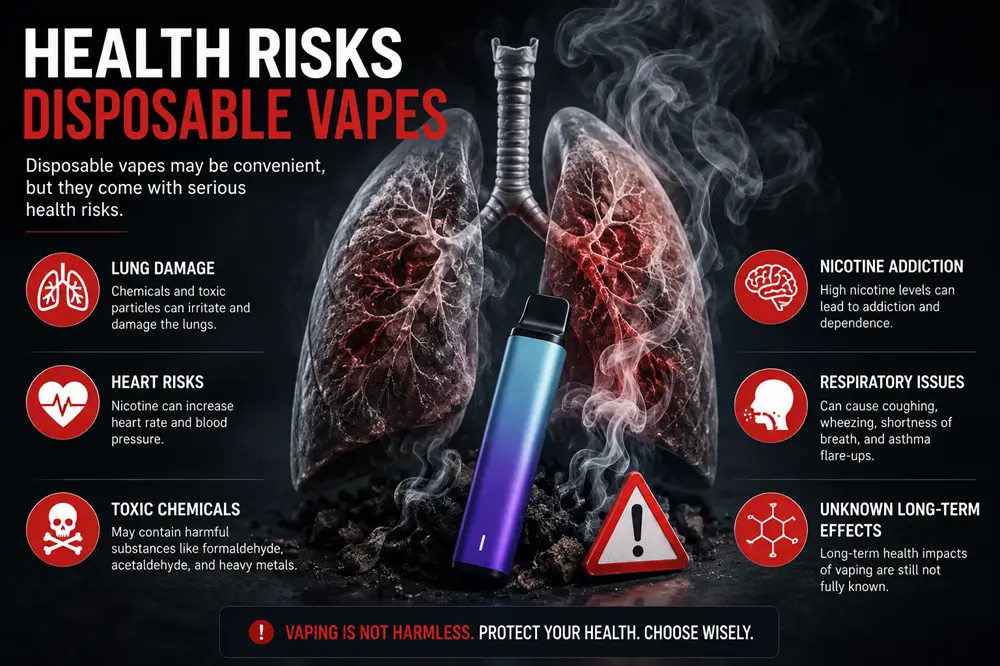
Disposable vapes carry real health risks: nicotine addiction, lung and airway damage, and the inhalation of toxic metals. A 2025 peer-reviewed study found that some disposables release more lead in a single day of use than 20 packs of cigarettes. Health authorities, including the CDC and the American Lung Association, state that e-cigarettes are not safe.
Disposable vapes have become the most common form of vaping, especially among teenagers and young adults. They are cheap, colorful, and sold in sweet flavors — which makes it easy to forget that they deliver an addictive drug and a mix of chemicals into the lungs. This guide summarizes what the evidence actually shows, drawing on data from the U.S. Centers for Disease Control and Prevention (CDC), the U.S. Food and Drug Administration (FDA), the American Lung Association, and recent peer-reviewed research.
What Are Disposable Vapes?
A disposable vape (also called a single-use e-cigarette) is a small, pre-filled, battery-powered device meant to be thrown away once the e-liquid or battery runs out. Popular brands include Elf Bar, Esco Bar, and Flum. Unlike older refillable devices, disposables are not designed to be refilled or recharged — although research shows many young users try to “hack” them anyway.
How Do Disposable Vapes Work?
Inside each device, a battery heats a metal coil that warms a liquid containing nicotine, flavorings, and base chemicals such as propylene glycol and vegetable glycerin. Heating turns the liquid into an aerosol — a fine mist of tiny particles that the user inhales. This aerosol is not simply “water vapor.” It carries nicotine, flavoring chemicals, and, as newer research shows, metals that leach from the device’s own internal parts.
Who Commonly Uses Disposable Vapes?
Disposables are especially popular among young people. According to the CDC, about 1.63 million U.S. middle and high school students (5.9%) currently used e-cigarettes in 2024, and among those users, 55.6% chose disposable devices — making them the single most common product type. Sweet and fruity flavors are a major driver: the vast majority of youth who vape use flavored products.
What Are the Main Health Risks of Disposable Vapes?
The main risks fall into three categories: nicotine addiction, damage to the lungs and airways, and exposure to toxic chemicals and metals. These risks are especially serious for adolescents, whose brains are still developing.
Short-Term Health Effects
In the short term, users commonly report throat and airway irritation, coughing, dry mouth, dizziness, and headaches. Because nicotine is a stimulant, it can also raise heart rate and blood pressure shortly after use. In rare but severe cases, vaping has been linked to a sudden, dangerous lung illness known as EVALI (explained below).
Long-Term Health Effects
Long-term risks are still being studied because these products are relatively new, but the evidence so far is concerning. A systematic review and meta-analysis found that vaping is associated with increased odds of asthma and chronic obstructive pulmonary disease (COPD), along with chronic cough, wheezing, and lung inflammation. Repeated exposure to toxic metals such as lead, nickel, and antimony has been linked to cancer, cardiovascular disease, and nerve damage.
What Chemicals Are Found in Disposable Vapes?
Nicotine Content
Nicotine is the primary active ingredient and the reason vapes are addictive. Modern disposables use nicotine salts, a form that feels smoother to inhale and allows very high concentrations without harshness. Analysis by the CDC Foundation and Truth Initiative found that the average nicotine strength of e-cigarettes rose 294% over five years, and that a single high-strength disposable can hold as much nicotine as several cartons of cigarettes.
Flavoring Agents and Additives
Flavorings make disposables appealing but are not harmless when inhaled. Many flavoring chemicals are approved as safe to eat, not to breathe. When e-liquid is heated, it can also form carbonyl compounds such as formaldehyde and acetaldehyde — reactive chemicals that can irritate and damage the airways. The CDC lists these among the harmful substances found in e-cigarette aerosol.
Toxic Metals Compared to Cigarettes
This is where recent research is most striking. In a 2025 study published in the peer-reviewed journal ACS Central Science, researchers at the University of California, Davis tested three popular disposable brands (Esco Bar, Flum Pebble, and Elf Bar). After a few hundred puffs, some devices released higher levels of toxic metals than older refillable vapes or even traditional cigarettes. The lead came from leaded copper alloys inside the devices that leached into the e-liquid. Nickel and antimony emissions in several devices exceeded cancer-risk thresholds.
One disposable vape released more lead in a single day of use than smoking nearly 20 packs of cigarettes (UC Davis / ACS Central Science, 2025).
The table below compares key exposures. Because disposables vary widely by brand and are largely untested, these figures illustrate documented findings rather than fixed values for every product.
| Factor | Disposable Vapes | Traditional Cigarettes | Source |
|---|---|---|---|
| Combustion & tar | No burning; no tar (aerosol instead of smoke) | Burns tobacco; produces tar and thousands of combustion chemicals | CDC |
| Nicotine | High-strength nicotine salts; one device can equal several cartons | Roughly 8–20 mg per cigarette; delivered dose varies | CDC Foundation / Truth Initiative |
| Toxic metals (e.g., lead, nickel, antimony) | Can exceed cigarette levels; lead up to ~52 ppm in aerosol from tested devices | Present, but lower than the disposables tested | ACS Central Science, 2025 |
| Carbonyls (formaldehyde, acetaldehyde) | Formed when e-liquid is overheated | Produced by combustion | CDC |
| EVALI (acute lung injury) | Documented risk, strongest with THC/black-market products | Not associated with EVALI | American Lung Association |
| Regulation | Most disposables are not FDA-authorized | Regulated tobacco product | FDA / HHS |
Are Disposable Vapes Safer Than Cigarettes?
Comparative Health Risks
The honest answer is: it’s complicated, and “safer” does not mean “safe.” For an adult who already smokes and completely switches, e-cigarettes may reduce exposure to some combustion-related toxins, which is why some researchers describe them as having harm-reduction potential compared with cigarettes. But the same research stresses that vaping is not harmless to the heart and lungs. And for the specific case of cheap disposables, the 2025 metals study suggests some may actually expose users to more of certain toxic metals than cigarettes do.
Misconceptions About Safety
A common myth is that vapes only produce “harmless water vapor.” They don’t — the aerosol contains nicotine, flavor chemicals, ultrafine particles, and metals. Another myth is that all vapes are safe because some are marketed as “clean.” For a never-smoker, especially a teenager, there is no health benefit to starting, and clear potential for harm.
Can Disposable Vapes Cause Lung or Heart Damage?
Evidence From Recent Studies
Yes — evidence points to both. On the lungs, studies link vaping to airway inflammation, chronic cough, worsened asthma, and higher COPD risk. The metals identified in the 2025 UC Davis study are known to raise the risk of lung disease. On the heart, nicotine raises heart rate and blood pressure, and inhaled metals like lead and nickel are associated with cardiovascular disease. Jonathan Shannahan, a Purdue University toxicologist who was not involved in the metals study, called the exposure levels “deeply concerning,” particularly because the products are marketed to young people.
“Our study highlights the hidden risk of these new and popular disposable electronic cigarettes,” said Brett Poulin, the UC Davis environmental toxicologist who led the 2025 research, pointing to hazardous levels of lead, nickel, and antimony.
Symptoms of Vape-Related Illness
EVALI stands for e-cigarette or vaping product use-associated lung injury — a severe, sometimes fatal lung illness first identified in 2019. By early 2020 the CDC had recorded more than 2,800 hospitalizations and 68 deaths, and over half of patients needed intensive care. The main chemical of concern was vitamin E acetate, found mostly in THC-containing and unregulated products. Warning signs include shortness of breath, cough, chest pain, fever, rapid heart rate, and stomach symptoms such as nausea, vomiting, or diarrhea. Anyone who vapes and develops these symptoms should seek medical care promptly.
Following the CDC’s EVALI findings, Dr. Albert Rizzo, chief medical officer of the American Lung Association, reinforced the organization’s core message that e-cigarettes are not safe.
Are Disposable Vapes Addictive?
Nicotine Dependence
Yes. Nicotine is highly addictive, and the nicotine-salt formulas in disposables deliver it quickly and smoothly, which can make dependence form fast. Many users find themselves reaching for the device constantly and struggling to stop — and most youth who vape say they want to quit and have tried.
Risks for Teenagers and Young Adults
Adolescence is the riskiest time to be exposed to nicotine. The CDC warns that nicotine can harm the developing brain — specifically the areas that control attention, learning, mood, and impulse control. Young people who vape are also three to four times more likely to go on to smoke traditional cigarettes. Because disposables are cheap, flavored, and easy to hide, they lower the barrier to a lifelong addiction.
Frequently Asked Questions
Can disposable vapes be used safely?
There is no established safe level of vaping. For adults who already smoke, fully switching may lower exposure to some toxins, but health authorities agree e-cigarettes are not safe — and for non-smokers and teens, the safest choice is not to start.
Are there any safe disposable vape brands?
No brand has been proven safe. In fact, most disposables sold in the U.S. — including popular names like Elf Bar and Flum — are not FDA-authorized. The 2025 metals study found concerning results even in leading brands, so “popular” does not mean “safe.”
What should I do if I feel unwell after vaping?
If you develop shortness of breath, chest pain, fever, cough, or stomach symptoms after vaping, stop using the product and seek medical care. Tell the clinician you vape and, if relevant, whether the product contained THC — this helps them check for EVALI.
How much nicotine is in a disposable vape?
It varies, but many high-strength disposables hold the nicotine equivalent of several cartons of cigarettes. Average e-cigarette nicotine strength has risen sharply — up nearly 300% over five years, according to CDC Foundation and Truth Initiative analysis.
Can vaping damage your lungs even without EVALI?
Yes. Beyond the acute injury of EVALI, regular vaping is associated with chronic cough, airway inflammation, worsened asthma, and higher COPD risk, plus exposure to metals linked to long-term lung and heart disease.
References
- Salazar, M. R., et al. (2025). Elevated Toxic Element Emissions from Popular Disposable E-Cigarettes: Sources, Life Cycle, and Health Risks. ACS Central Science. pubs.acs.org · ACS summary
- Centers for Disease Control and Prevention — Health Effects of Vaping and E-Cigarette Use Among Youth
- American Lung Association — EVALI overview and statement on e-cigarette safety
- U.S. HHS / Surgeon General — Youth Vaping
- CDC Foundation & Truth Initiative — Monitoring E-Cigarette Trends (2024)
- Systematic review & meta-analysis on respiratory effects of vaping — NCBI/PMC
- Cardiopulmonary outcomes review — Am. J. Physiology-Heart (2025)
This article is for general information and is not medical advice. If you are concerned about your health or want help quitting nicotine, speak with a licensed healthcare provider.